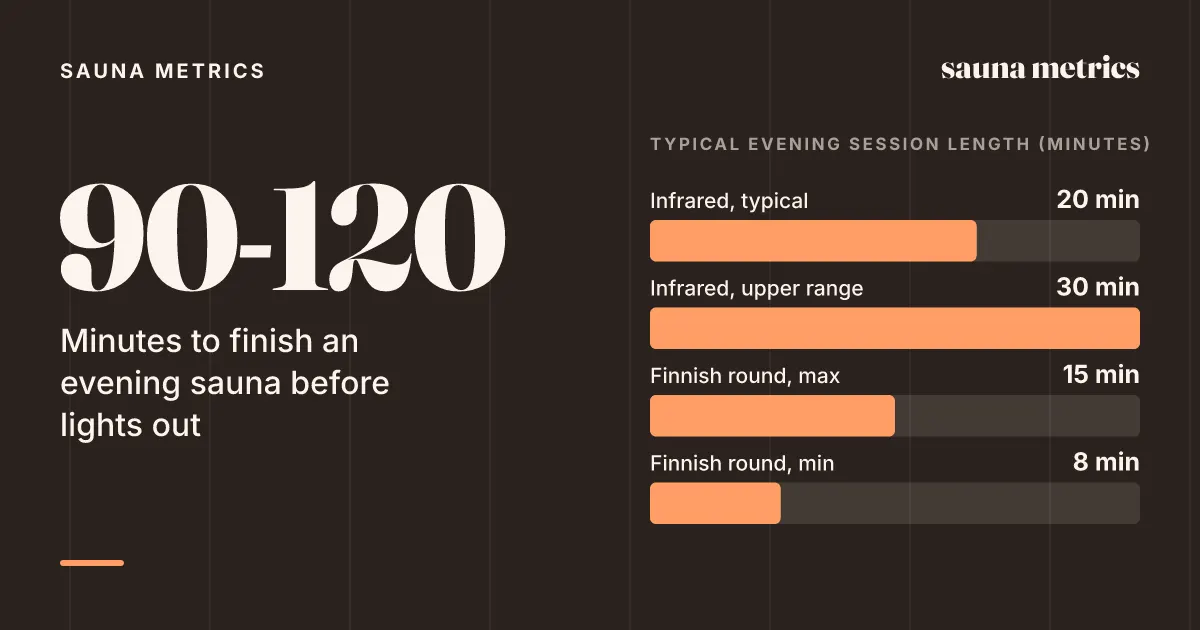
A sauna before bed is fine for most healthy adults, as long as the session ends 90 to 120 minutes before lights out. Heating up and then cooling down can help your core temperature fall at bedtime, which goes with falling asleep. Going straight from a hot session to bed does the opposite: your body is still warm and your heart rate is still raised.
Is it okay to have a sauna before bed? Yes, with a gap
For most healthy adults, yes. The gap matters more than the sauna itself. Responses vary with sauna type, session length, caffeine, alcohol and your own heat tolerance, so treat the 90 to 120 minutes as a starting point to test, not a rule.
How the sauna prepares your body for sleep
Falling asleep goes with a drop in core body temperature. Heat exposure raises skin blood flow and sweating, and the cool-down afterwards may make that drop easier. Research on warm baths and showers taken one to two hours before bed points in the same direction. Those studies measured sleep onset and sleep quality in groups of people. They show an association, not that the same effect will happen for you.
The second mechanism is calm. After the heat, the cool-down and the quiet that follows can lower perceived stress. Heart rate and heart rate variability (HRV) are the signals to watch, and a change in them is not guaranteed.
Hormones are less clear. Some small studies link heat exposure to a short-term rise in growth hormone. Evidence on melatonin is limited and mixed, so do not count on it. For the wider picture, see our detailed guide on sauna and sleep quality.
The 90-minute rule: when to finish your evening sauna
Aim to finish 1.5 to 2 hours before lights out. That leaves time to cool down, drink some water and wind down in dim light. By bedtime, your body temperature and heart rate have had time to settle.
| Sauna type | Typical session | Cool-down | Suggested end time before bed |
|---|---|---|---|
| Finnish | 2 to 3 rounds of 8–15 min at 80–90 °C (176–194 °F) | Cool shower or fresh air between rounds, plus 10+ min after | About 2 hours |
| Infrared | About 15–30 min, lower air temperature | Rest and a cool shower if needed | 90 min to 2 hours |
| Steam room | About 10–20 min at roughly 40–50 °C (104–122 °F), high humidity | Cool shower, rest | 90 min to 2 hours |
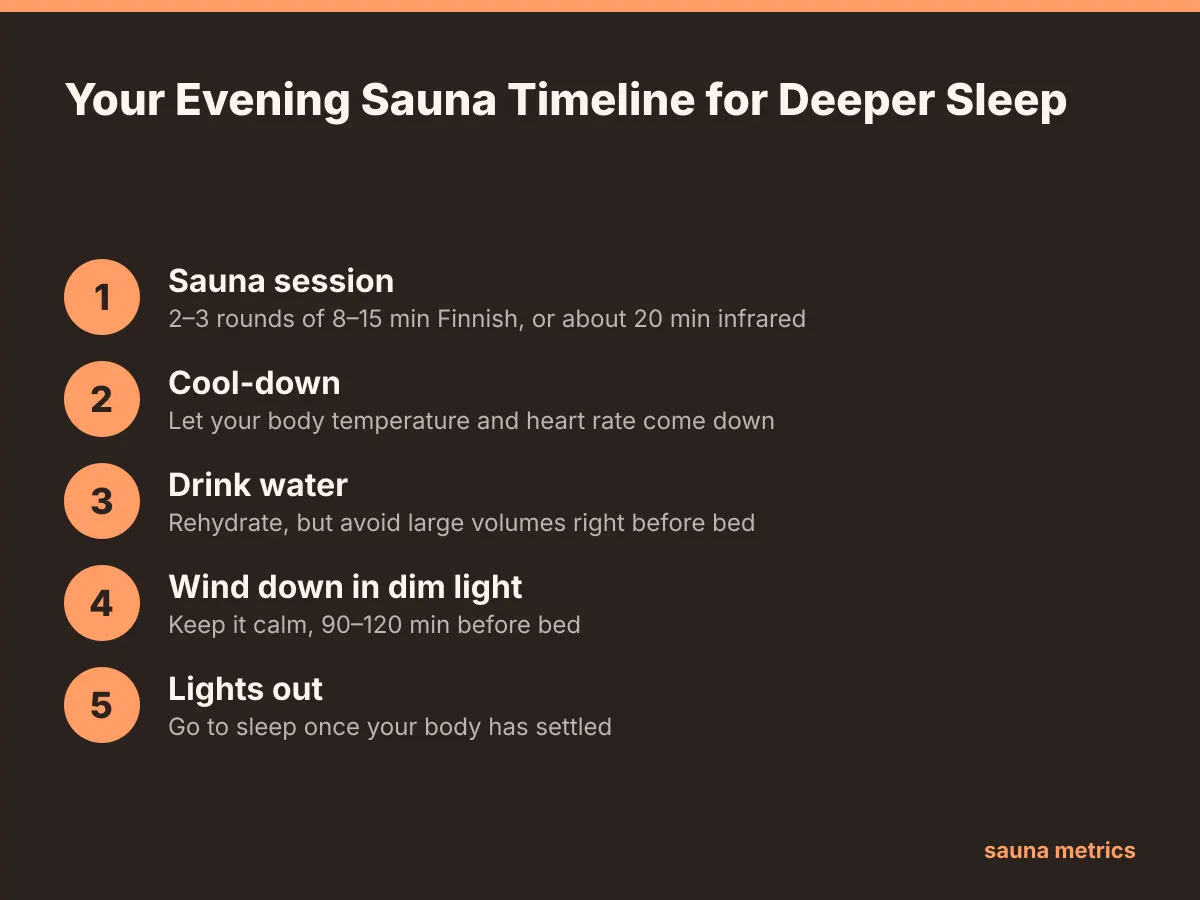
A hot Finnish session with intense rounds may call for the full 2 hours. A gentle infrared session may need a little less. To compare formats, read infrared vs traditional sauna: which fits your routine. For settings, see the sauna temperature guide for every session.
Sauna morning or night: which is better?
Neither wins for everyone. A morning session suits alertness and gives you a routine anchor, and it has no effect on sleep timing. Claims about a morning metabolic kickstart are modest, so do not rely on them. An evening session suits relaxation and recovery after training, and may make falling asleep easier if you time it correctly.
| Goal | Best slot | What to watch |
|---|---|---|
| Alertness and routine | Morning | Consistency, mood and stress inputs |
| Recovery after training | Evening, 1.5–2 h before bed | Resting heart rate, HRV the next morning |
| Easier sleep onset | Evening, with a gap | Time to fall asleep, sleep stages |
Consistency matters more than the perfect hour. A sauna at night also works for shift workers and late trainers, provided they keep the same gap before sleep.
Is 20 minutes in an infrared sauna enough for sleep?
Yes, 20 minutes is a common and reasonable length for an evening infrared session. No proven threshold exists, so adjust to comfort. Infrared sessions usually run 15 to 30 minutes, and Finnish sessions 2 to 3 rounds of 8 to 15 minutes. Shorten the session if you feel lightheaded. For the evidence behind infrared, see what the science shows on infrared sauna benefits.
Heart rate shows how hard the session was for you. With Sauna Metrics Pro, the Apple Watch app displays your heart rate live and shows how quickly it comes down afterwards. These are measurements, and they depend on your equipment and permissions.
Drink water before and after, and add electrolytes if you sweat a lot. Avoid large volumes right before bed to limit bathroom trips, and skip alcohol. Our guide on what to drink after the sauna covers the details.
How to track whether the sauna is improving your sleep
Compare time to fall asleep, sleep stages, resting heart rate, HRV and how rested you feel. Keep the data types apart: heart rate, HRV and sleep come from Apple Health and are measurements. Sauna temperature, humidity, mood, stress and session time are your own inputs. The session score is an estimate and is not medical.
In Sauna Metrics, log each session with the timer and rounds, temperature, cool-down, water and mood. Pro's sleep analysis and biometric dashboard then put your sauna nights next to your normal nights.
One night proves nothing, and sleep trackers are approximate. You need several nights of each type. Change one variable at a time (end time, duration or temperature) and keep what both the data and your own feeling support.
Your 2-week evening sauna test: a checklist
- Week 1: finish the sauna 2 hours before bed on chosen nights, and alternate with normal nights.
- Week 2: try 90 minutes, or a shorter session. Change only one variable.
- Log every session in Sauna Metrics and review sleep and HRV trends in Pro.
- Stop and seek medical advice if you feel dizzy, have chest pain or sleep clearly worse.
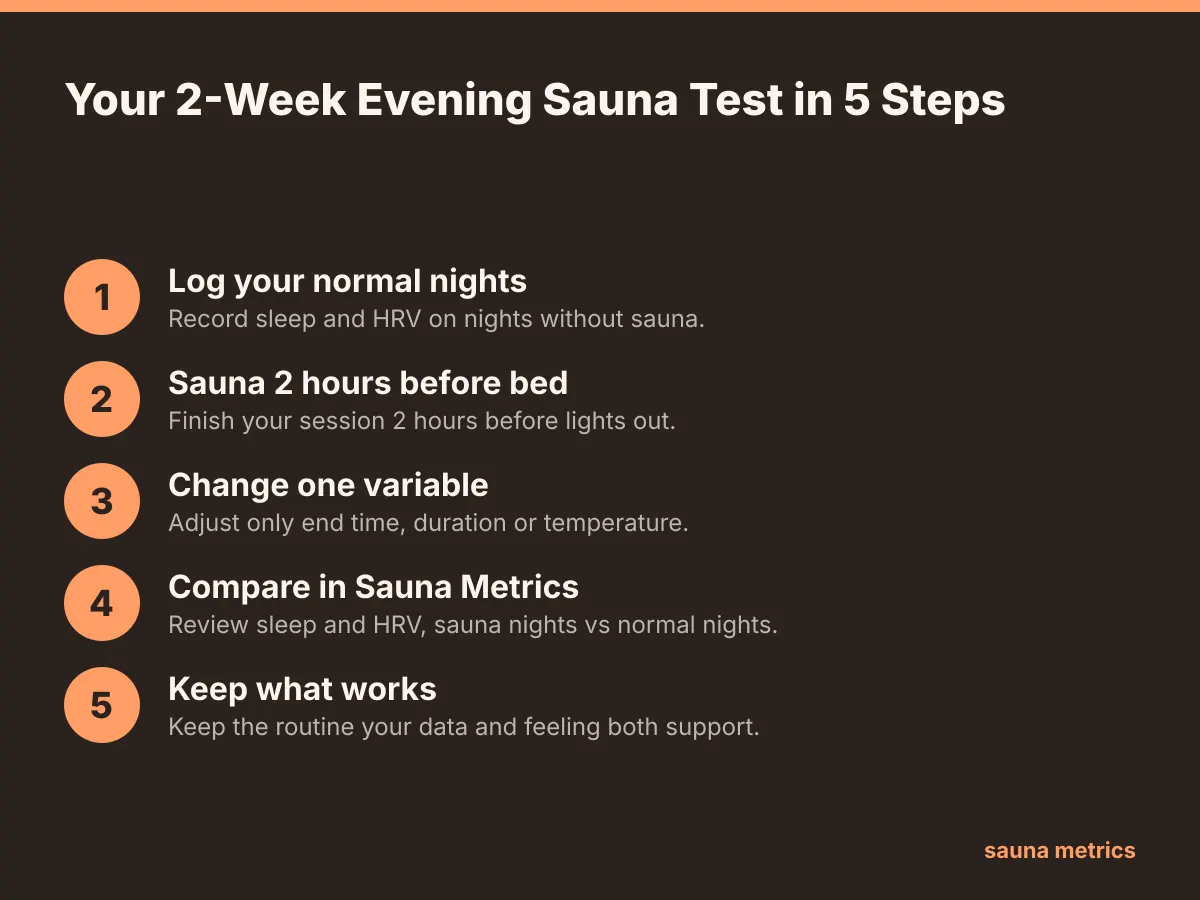
Download Sauna Metrics on iPhone to run the test. Your data stays on the device, with no account.
Is it okay to have a sauna before bed?
For most healthy adults, yes, if the session ends 90 to 120 minutes before lights out. People with heart conditions, pregnant women and those on certain medication should ask a doctor first.
Is 20 minutes in an infrared sauna enough?
It is a common, reasonable length for an evening session. No proven threshold exists, so adjust to comfort and stop if you feel dizzy.
What toxins do infrared saunas remove?
Sweat is mostly water and electrolytes, and your liver and kidneys do the actual filtering. Small studies have found trace compounds in sweat, but there is no solid proof that a sauna meaningfully detoxifies the body.
Can a sauna help with anxiety?
Some people feel calmer after a session, and research on heat exposure and mood is early and limited. A sauna is not a treatment for anxiety. Log your stress before and after in Sauna Metrics to see your own pattern.