Infrared vs traditional sauna: the short answer
In the infrared vs traditional sauna question, the difference is the heat source. A traditional (Finnish) sauna heats the air, and the hot air heats you by convection. An infrared sauna uses panels that warm your body directly with radiant heat, so the cabin air stays much cooler.
Neither is better for everyone. The right choice depends on your heat tolerance, your space, your energy budget, and whether you want steam and the social ritual. The more useful question is the physiological response you get, and you can measure that whatever the heat source.
| Criterion | Traditional (Finnish) | Infrared |
|---|---|---|
| Heat source | Stove heating air and stones (convection) | Panels emitting infrared light (radiant heat) |
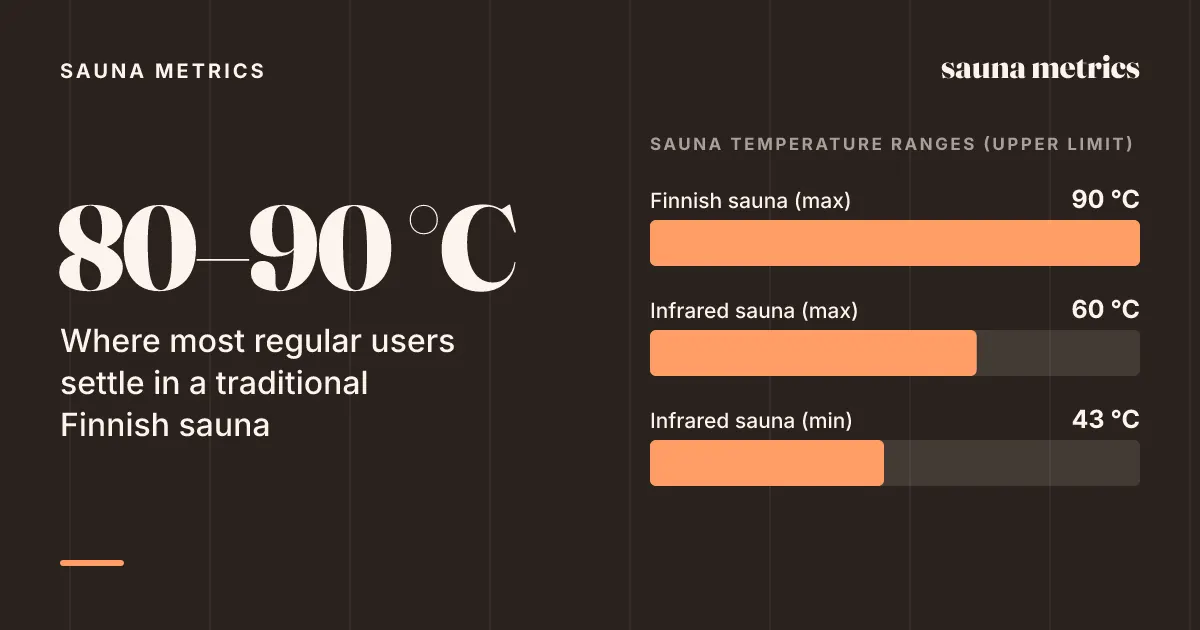
| Air temperature | 75–95 °C (170–200 °F) | 45–65 °C (120–150 °F) |
| Humidity | Low, with brief spikes from löyly | Dry air, no steam |
| Warm-up | Typically longer | Typically shorter |
| Typical feel | Intense, enveloping heat | Gentler air, deep warmth on the skin |
This guide uses Sauna Metrics to show how you can compare the two with your own data instead of relying on marketing claims.
How do infrared saunas work compared with a traditional heater?
In a traditional sauna, a stove heats the room air and a pile of stones. Throwing water on the stones creates löyly, a burst of steam. The heat reaches your skin through the hot air around you.
An infrared sauna works differently. Its panels emit infrared light, a part of the electromagnetic spectrum just beyond visible red. Your skin and the tissue just beneath it absorb that energy and warm up directly, without the air having to reach a high temperature.
Infrared is non-ionizing radiation, not X-rays. Electromagnetic field (EMF) levels do vary by manufacturer and model, so check the product specifications rather than assume.
You will also see near, mid and far infrared in product descriptions. These are mostly marketing categories. For your routine, what counts is the cabin air temperature and how the session feels.
Temperature and humidity: why infrared feels gentler and what the 200 rule means
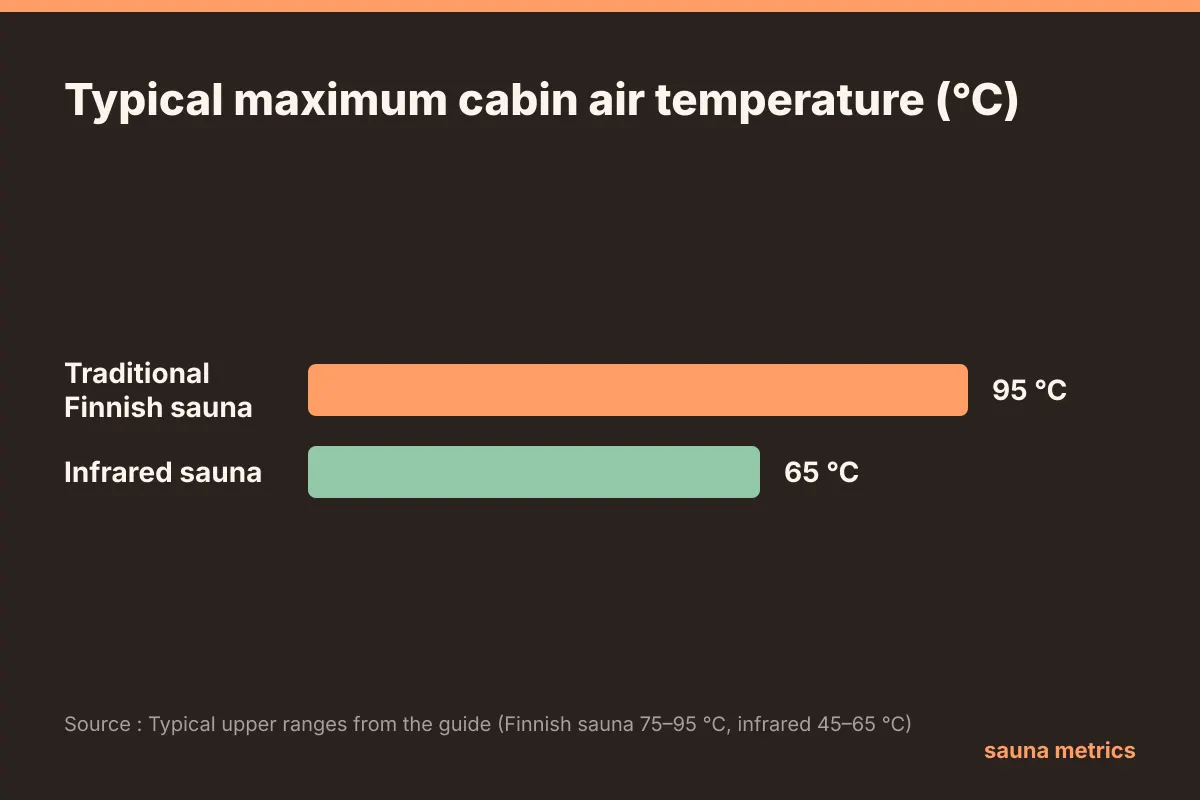
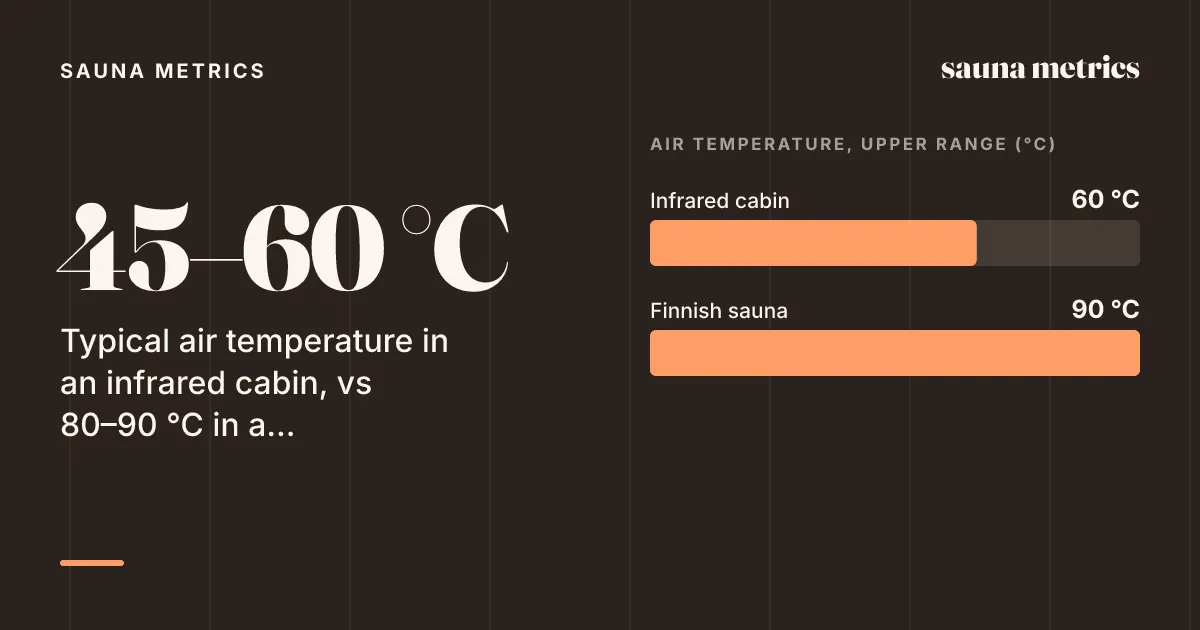
A Finnish sauna usually runs at about 75–95 °C (170–200 °F). Humidity is low, then rises for a moment each time you pour water on the stones. An infrared cabin runs at about 45–65 °C (120–150 °F) with dry air, so it feels less intense.
Infrared can still make you sweat heavily, because the radiant heat warms the body directly. Keep in mind that sweat volume is an estimate and says nothing about benefit by itself.
What is the 200 rule in a sauna?
The 200 rule is an informal rule of thumb among sauna users. It says the temperature in °F plus the humidity in % should stay around 200 or below for comfort. At 180 °F with 20% humidity you are at 200, for example.
In the app, temperature and humidity are user inputs: you read them from the cabin thermometer or hygrometer and enter them yourself.
Is an infrared sauna as good as a regular sauna for your body?
The honest answer is that we do not know that they are equivalent. Heat exposure raises heart rate in both. Traditional sessions at a higher air temperature tend to be more demanding for many people, but individual response varies, so your own data is the best guide.
Heat stress in general can trigger heat shock proteins. The evidence is stronger for hot-air and whole-body heating than specifically for infrared, so it would be wrong to claim they are the same.
Large observational studies have linked frequent Finnish sauna use to better cardiovascular outcomes. They followed Finnish men and show associations, not proof of cause and effect. They should not be transferred automatically to infrared. For what the research covers, read what the science shows about infrared sauna benefits.
How to compare the two on yourself
- During the session: heart rate from Apple Watch, a measurement that depends on your equipment and permissions (Pro).
- The next morning: HRV and resting heart rate read from Apple Health.
- Over several weeks: sleep trends, compared by sauna type.
Pros and cons for your home and routine
| Criterion | Traditional | Infrared |
|---|---|---|
| Steam and löyly | Yes | No |
| Heat level | Higher air temperature | Lower air temperature |
| Warm-up | Longer | Faster start-up |
| Running cost | More energy and installation constraints | Usually lower |
| Heat-sensitive people | Can be hard to tolerate | Usually easier |
| Social ritual | Strong tradition of sharing | Often a smaller, individual setup |
| Quality | Established designs | Varies between brands |
Dry sauna vs infrared, and the benefits of a dry sauna
The term dry sauna can mean a traditional sauna with low humidity, which makes dry sauna vs infrared a slightly fuzzy comparison. The commonly cited benefits of regular dry heat are relaxation, sweating, a steady routine and a cardiovascular load similar to light exercise.
On detox and skin, be cautious. Sweat is mostly water and electrolytes, and strong claims about detoxification or skin improvement are not well supported.
Is there a combination of infrared and traditional saunas?
Yes. Some hybrid cabins combine a stove with infrared panels. It is an option, not a necessity, and you can track it like any other session.
Whichever you choose, duration and weekly rhythm matter more than the label. See ideal sauna duration and frequency for the details.
How to track both types of sauna with Sauna Metrics
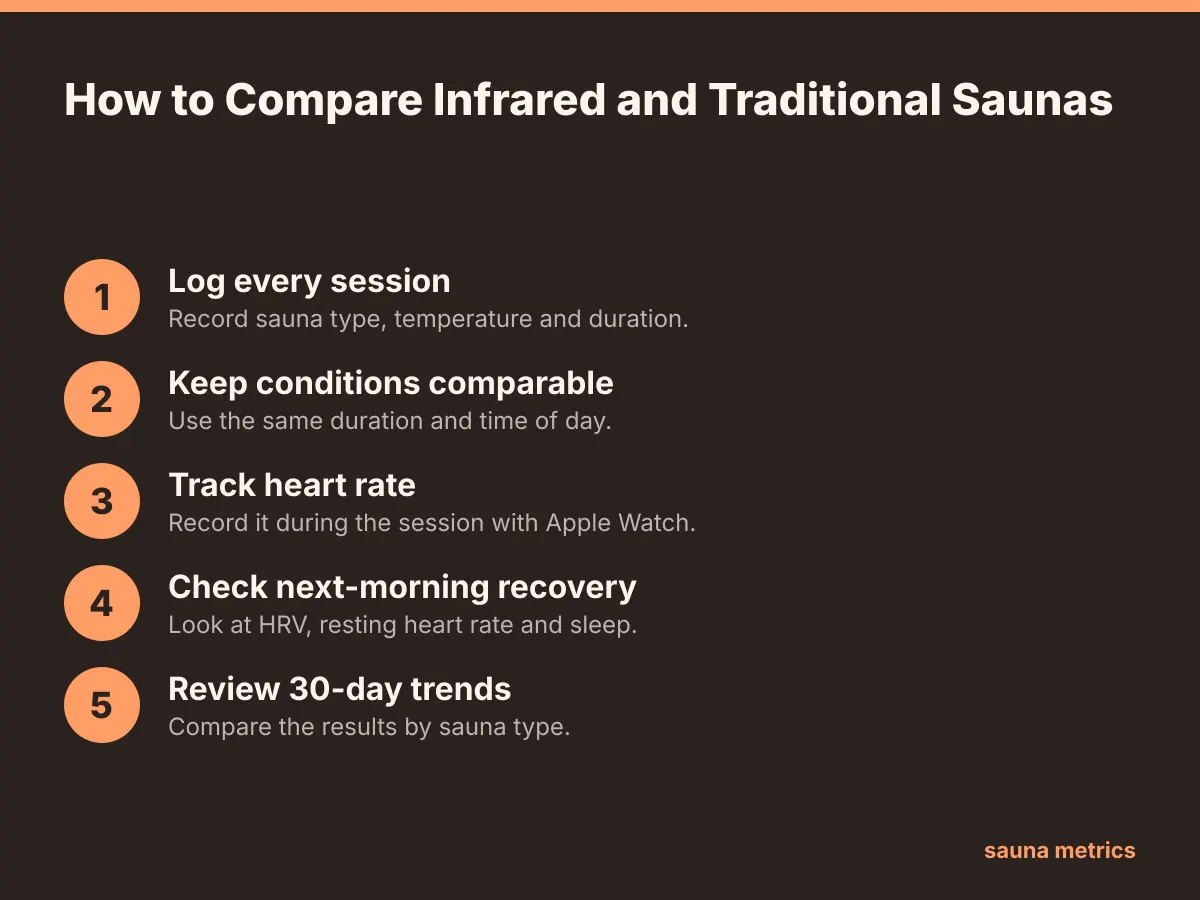
For a traditional session, log your rounds and breaks, the temperature, the humidity, the cool-down, water, and your mood and stress before and after. For an infrared session, choose the infrared sauna type and log the duration and cabin temperature. There is no steam to record.
With Pro, the Apple Watch app adds live heart rate, HRV and recovery, and sleep analysis. These are measurements and depend on your equipment and permissions. The session score out of 100 is a non-medical estimate.
To compare over 30 days, keep the same duration and time of day. Then look at next-morning HRV, resting heart rate and sleep by sauna type. These are observations about your own habits, not a diagnosis.
Try it with a sauna log app for iPhone. Your data stays on the device, and there is no account.
Quick checklist to choose and compare your sauna
- Choose traditional if you want steam, high heat and sharing. Choose infrared if you want a quick start, lower heat and a small space.
- Run each type for two to three weeks with comparable duration and timing.
- Log temperature, humidity, duration and how you feel.
- Check heart rate during sessions, then HRV and sleep the next morning.
- Keep what fits your recovery, and adjust with medical advice if you have a health condition.
How do infrared saunas work?
Infrared panels emit infrared light, which your skin and the tissue just beneath it absorb. This warms your body directly, so the cabin air can stay at about 45–65 °C (120–150 °F).
What is the 200 rule in a sauna?
It is an informal rule of thumb: the temperature in °F plus the humidity in % should stay around 200 or below for comfort. It is not a scientific standard and mostly applies to traditional saunas.
What are the benefits of using a dry sauna?
Regular users commonly report relaxation, sweating and a steady routine, and heat exposure gives a cardiovascular load similar to light exercise. Studies linking sauna use to health outcomes are observational and do not prove cause and effect.
Is there a combination of infrared and traditional saunas?
Yes. Some hybrid cabins combine a stove with infrared panels. It is an option rather than a requirement.