Infrared sauna benefits in short: what is supported and what is not
The infrared sauna benefits with the best support are cardiovascular and relaxation-related: heat raises heart rate, widens blood vessels and gives you a quiet block of time. Muscle recovery is plausible but mixed. Weight loss and 'detox' are the most overstated claims. Below, each of the ten commonly cited benefits is graded by how solid the evidence is.
One caveat applies throughout. Much of the long-term data on heart health and longevity comes from observational studies of Finnish sauna use. They show statistical associations, not individual cause and effect, and infrared-specific data is smaller.
| # | Benefit | Evidence level | Type of evidence |
|---|---|---|---|
| 1 | Heat shock proteins (cell repair) | Limited | Mechanism, lab and exercise physiology |
| 2 | Circulation and blood pressure | Stronger, short term | Small clinical trials |
| 3 | Waon therapy in heart failure | Stronger, specific population | Clinical studies under medical supervision |
| 4 | Muscle soreness | Limited | Small trials, mostly subjective ratings |
| 5 | Relaxation and stress | Stronger for how you feel | Self-reported, consistent |
| 6 | Sleep | Limited | Individual reports, timing-dependent |
| 7 | Skin | Weak | Temporary comfort, thin data on lasting effects |
| 8 | Calories burned | Modest | Estimates only |
| 9 | Sweat and fluid loss | Real, but not a benefit by itself | Physiology, mostly water |
| 10 | 'Detox' | Unsupported | Trace compounds in sweat only |
Sauna Metrics keeps the sources of its data separate. Measurements are heart rate, HRV, resting heart rate and sleep read from Apple Health, depending on your equipment and permissions. User inputs are temperature, humidity, water, mood and stress. Estimates are sweat and calories, and the session score is non-medical.
How infrared differs from a Finnish sauna
An infrared cabin uses panels that emit radiant heat, which the skin and the tissue just below it absorb. A Finnish sauna heats the air around you, and you feel it through that air. The result is a different sensation, not necessarily a different outcome.
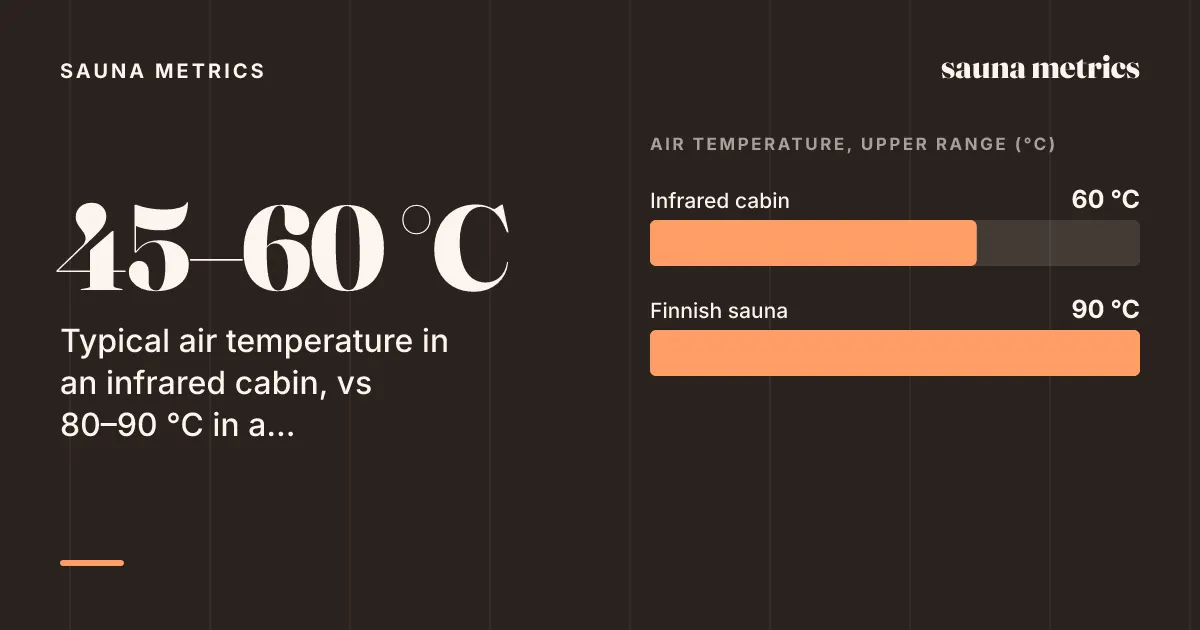
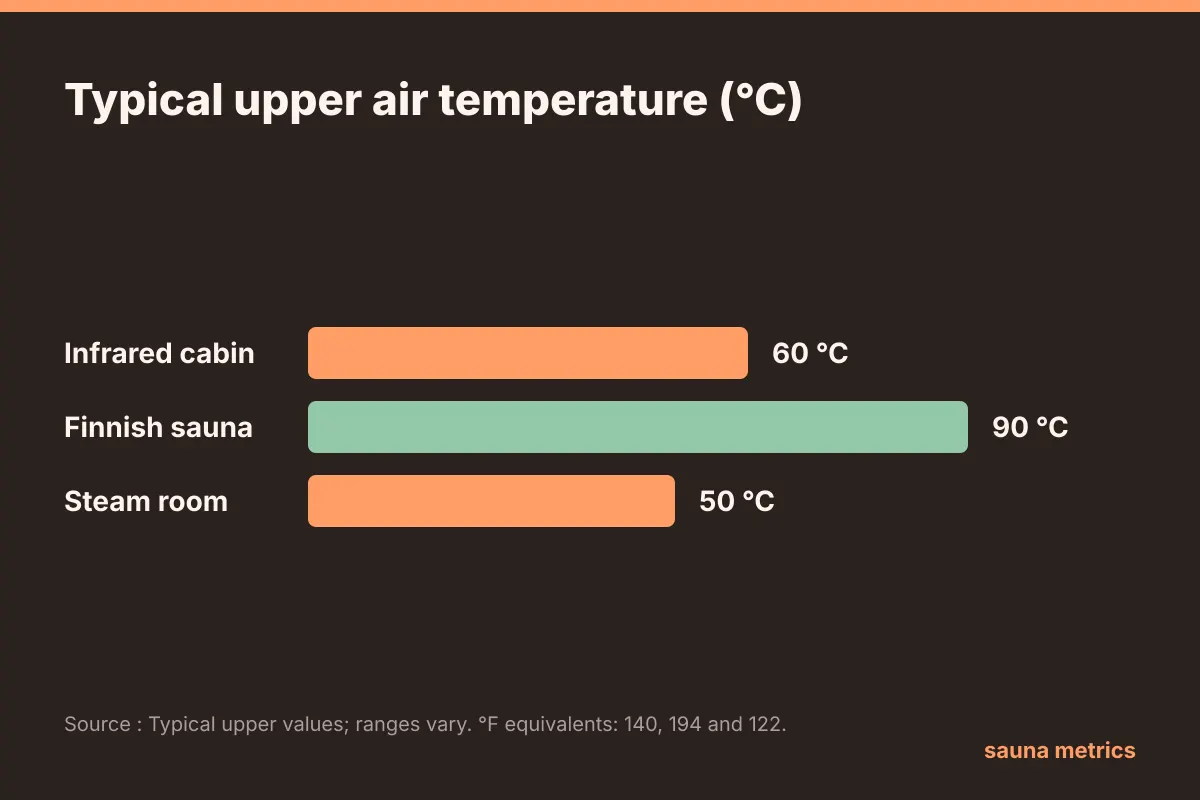
Air temperature in an infrared cabin is typically about 45–60 °C (113–140 °F), against 80–90 °C (176–194 °F) in a Finnish sauna. The heat feels gentler, so sessions are often longer. How much heat your body takes on depends on session length and cabin type, not only on the number on the thermostat, so no one can honestly claim deeper or more efficient heating without data for your cabin.
Benefits 1 to 3: heat shock proteins, blood pressure and Waon therapy
Benefit 1, heat shock proteins. Heat stress triggers these cellular repair proteins in lab and exercise-physiology research. The link to long-term outcomes in people remains indirect, so treat longevity as a hypothesis, not a promise.
Benefit 2, circulation and blood pressure. Heat dilates blood vessels and raises heart rate in a way that resembles light exercise. Small trials report short-term effects on blood pressure, and results vary from person to person. Observational studies in Finnish cohorts associate frequent sauna use with lower cardiovascular risk, but that is a statistical pattern, not proof for any one person.
Benefit 3, Waon therapy. This Japanese protocol uses a far-infrared dry sauna at a moderate temperature of about 60 °C (140 °F), followed by rest. It has been studied in people with chronic heart failure under medical supervision. It is not a model for treating yourself.
Benefits 4 to 6: muscle recovery, stress relief and sleep
Benefit 4, muscle soreness. Some small studies suggest lower perceived soreness after hard training. The evidence is mixed and rests mostly on subjective ratings. Many athletes use infrared for comfort and routine rather than a proven performance edge.
Benefit 5, relaxation and stress. Gentle heat and 20 to 30 quiet minutes produce the most consistent effect, and it is subjective. In the app, mood and stress before and after are your own inputs, not biomarkers. They are still useful for seeing what a session does for you.
Benefit 6, sleep. Some people sleep better after an evening session. Timing matters, though: a session too close to bedtime can keep heart rate up and delay sleep. Your Apple Health sleep data will show which applies to you.
To look at the recovery window, compare sessions on training days with sessions on rest days over several weeks. A single week tells you very little.
Benefits 7 to 10: skin, calories, sweat and the detox myth
Benefit 7, skin. Better circulation gives temporary skin comfort and a flushed look. Evidence for lasting skin benefits is thin.
Benefit 8, calories. Heart rate rises and energy expenditure sits modestly above resting levels, far below that of real exercise. Any calorie figure is an estimate, not a measurement. There is no evidence that sauna alone leads to lasting fat loss.
Benefit 9, sweat. How much you sweat in a sauna depends on cabin temperature, session length, body size, acclimatization and hydration. There is no universal figure. Weight lost in a session is almost entirely water and returns when you drink, so weigh yourself before and after to see your own number. For replacement, see how much water to drink in our hydration guide.
Benefit 10, 'detox'. Sweat contains trace amounts of some compounds, but the liver and kidneys do the clearing. As a main benefit, detox is unsupported.
How long to sit in an infrared sauna and why to wait before showering
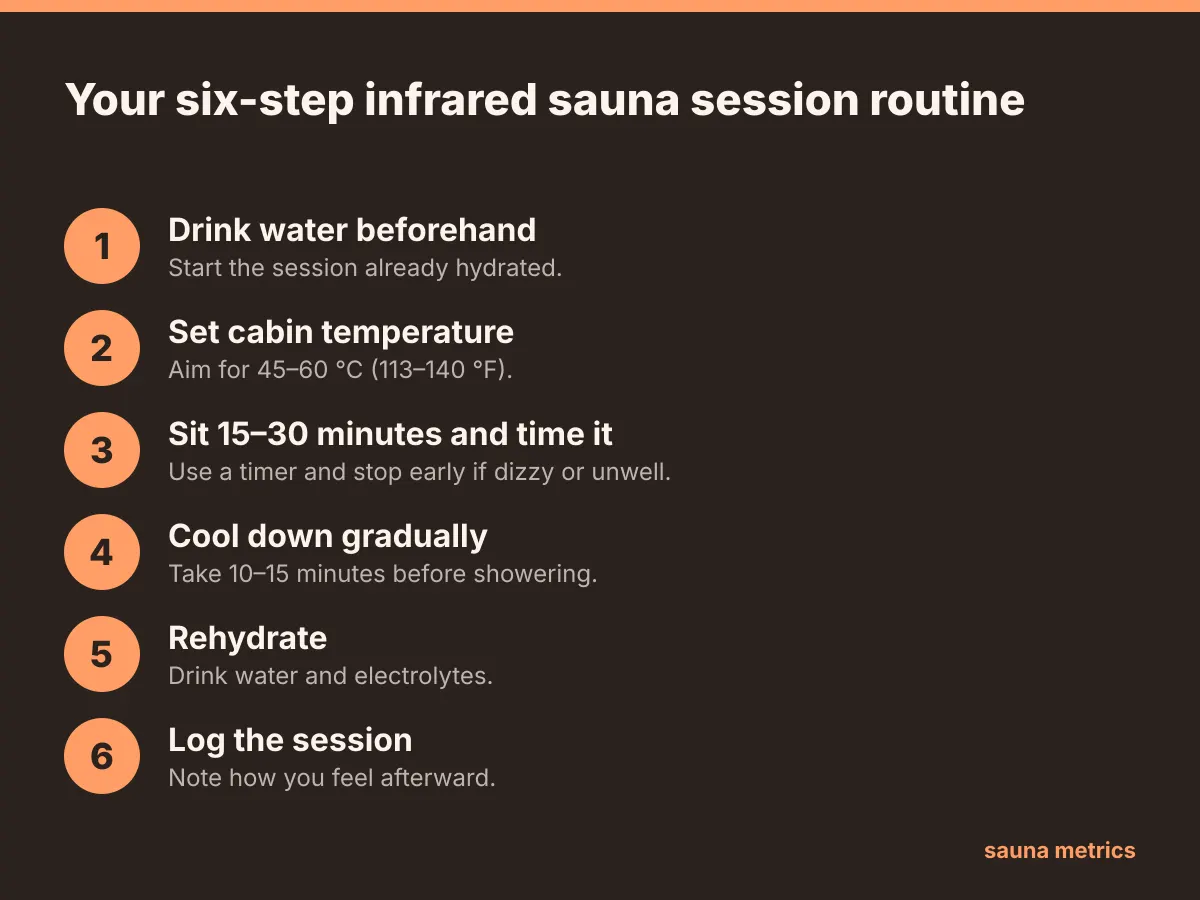
Beginners can start with 10 to 15 minutes. Regular users commonly sit 20 to 30 minutes at 45–60 °C (113–140 °F). Stop earlier if you feel dizzy or unwell. Build up gradually: two to four sessions per week is a common routine, as a habit and not a prescription.
Showering afterward does no harm. Many people wait 10 to 15 minutes so heart rate and skin temperature come down first. A very cold shower right away is a stronger stress on the body, so read about combining heat with cold plunge before you try it.
Drink water before and after, add electrolytes if you sweat heavily, and skip alcohol. Here is the routine in six steps.
Track your own response with Sauna Metrics: a checklist
Published benefits are averages from studies. What matters to you is your own response, and a log makes it visible. In Sauna Metrics, set the sauna type to infrared and log the timer, cabin temperature, humidity, water, and mood and stress before and after.
With Pro, Apple Watch shows live heart rate during the session. HRV, resting heart rate and sleep come from Apple Health, depending on your equipment and permissions. Sweat and calorie values in the app are estimates, and the session score is non-medical.
- Log every session for 4 weeks, at the same time of day.
- Note your training load on each day.
- Record temperature, humidity, water, mood and stress.
- Review HRV and resting heart rate trends, sleep after evening sessions, and soreness after training days.
- Adjust duration or timing, and treat what you see as patterns, not proof of cause.
Download Sauna Metrics on iPhone to start the log. Your data stays on the device, with no account.
What is the downside to an infrared sauna?
The main risks are dehydration, dizziness and a drop in blood pressure, especially with long sessions, alcohol or certain heart conditions. The heavily marketed claims on weight loss and detox are also not supported. Ask a doctor first if you have a heart condition or are pregnant.
How long should I sit in an infrared sauna?
Beginners can start with 10 to 15 minutes. Regular users commonly sit 20 to 30 minutes at 45–60 °C (113–140 °F). Stop sooner if you feel dizzy or unwell.
Why not shower after infrared sauna?
There is no harm in showering. Many people wait 10 to 15 minutes so heart rate and skin temperature settle, and a very cold shower straight away is a stronger stress on the body.
Which is better, red light therapy or infrared sauna?
They do different things. Red light therapy applies light to a limited area of skin without heating the whole body, while an infrared sauna raises your body's heat load. Neither is better in general, so choose based on your goal.