Sauna for runners can support endurance through heat adaptation when sessions follow a run, but the evidence is limited and results vary from person to person. It adds to training and does not replace it. This guide gives a post-run protocol with numbers, then shows how to check with HRV, resting heart rate and sleep whether it works for you.
Is sauna for runners worth it? What the research shows and what it doesn't
The study most often cited is Scoon and colleagues (2007, Journal of Science and Medicine in Sport). It followed a small group of competitive male distance runners who added sauna sessions right after their training runs for about three weeks. The researchers measured endurance (time to exhaustion) and plasma volume, and they reported a better endurance outcome. Check the exact figures in the paper itself before quoting them.
The proposed mechanism is plasma volume expansion. Regular heat exposure is associated with more circulating plasma, which partly overlaps with what hot-weather or altitude training produces. A larger plasma volume can support stroke volume and sweating, so the heart may work less at a given pace. That is an expectation to verify in your own data, not a promise.
The limits matter. The sample was small, it was one population, and later studies have given mixed results. An observed improvement in a group does not prove the same effect for every runner.
The post-run sauna protocol: timing, duration and temperature
The practical window is right after an easy or moderate run. The heat is added to a session you have already done, so it does not compete with your quality work. Wait until your heart rate has come down and you have had water.
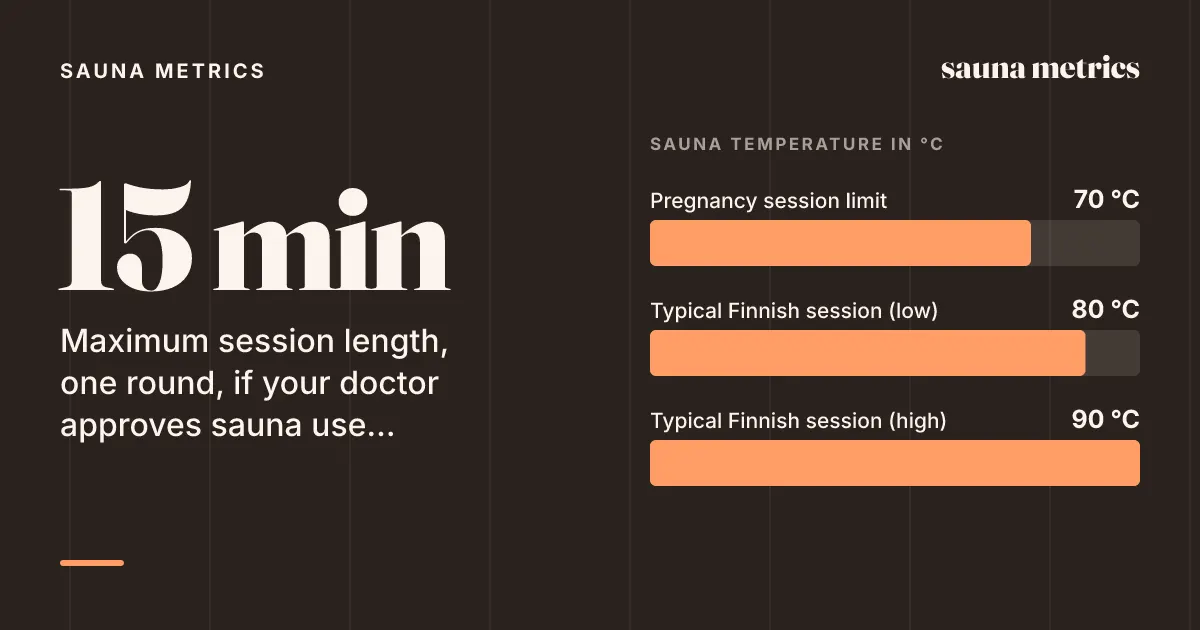
A conservative starting point is one or two rounds of 10 to 15 minutes at 80–90 °C (176–194 °F) in a Finnish sauna, with a cool-down between rounds. This is a starting range, not a prescription. The ideal sauna temperature for each session depends on your experience and the sauna type.
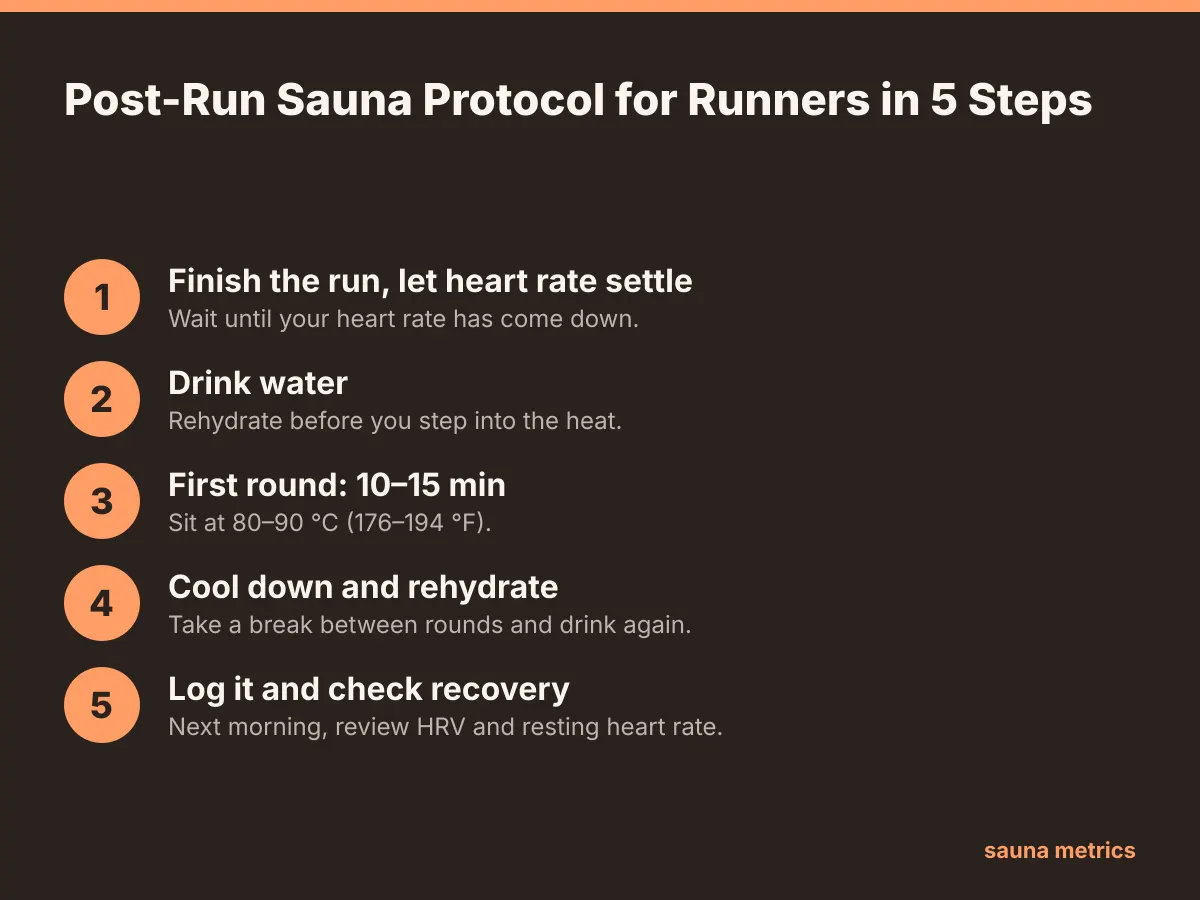
- Finish the run and let your heart rate settle.
- Drink water.
- Take a first round of 10 to 15 minutes at 80–90 °C (176–194 °F).
- Cool down and rehydrate.
- Log the session, then check HRV and resting heart rate the next morning.
Build up slowly. Begin with 2 sessions a week and add a third only if your sleep and resting heart rate stay stable. After a long or hard run your body is already loaded, so shorten the session rather than extend it.
You will often read that heat "flushes out" metabolic waste through the lymphatic system. That claim is popular but weakly supported. What heat reliably does is relax you and raise skin blood flow, and sweat is mostly water and salts.
In Sauna Metrics, the timer runs each round and each break. You log the temperature you set, then note how you felt before and after.
Is it good to run after a sauna?
Usually not for a quality session. After a sauna you have lost fluid and your heart rate is raised, so the same pace feels harder and dizziness is more likely.
If you have to, keep it an easy run, after full rehydration and a pause. The better order is to run first and sauna after. Running in the heat on purpose is a separate and more demanding tool, and it is not the same as sauna use.
Sauna recovery tracking: HRV, resting heart rate and sleep
Most sauna advice for athletes stops at physiology. To know whether it helps you, you need data. First, separate the types. Heart rate, HRV, resting heart rate and sleep are measurements read from Apple Health, and they depend on your equipment and permissions. Temperature, humidity, water, mood and stress are your own inputs. The session score is a non-medical estimate.
- HRV: compare your morning trend after hard runs with and without a sauna session. Look at the 7-day trend, not a single reading, and compare against your own baseline, since HRV differs a lot between people.
- Resting heart rate: a sustained rise over several days, together with poor sleep, is a signal to reduce load. That can mean skipping the sauna too. It is not a diagnosis.
- Sleep: review about 30 days of session logs next to your sleep data. Look at whether sauna frequency or timing lines up with better or worse nights. This shows an association in your own data, not causation.
To set this up, log every session in Sauna Metrics. With the Pro Apple Watch app you get live heart rate and HRV/recovery, and you can track heart rate on Apple Watch during the session itself. The biometric dashboard then shows sleep and recovery trends next to your sauna history.
Use the calendar and the weekly goal to keep your frequency constant while you test. If you change the number of sessions every week, the data cannot tell you anything.
The 200 rule and safety for runners
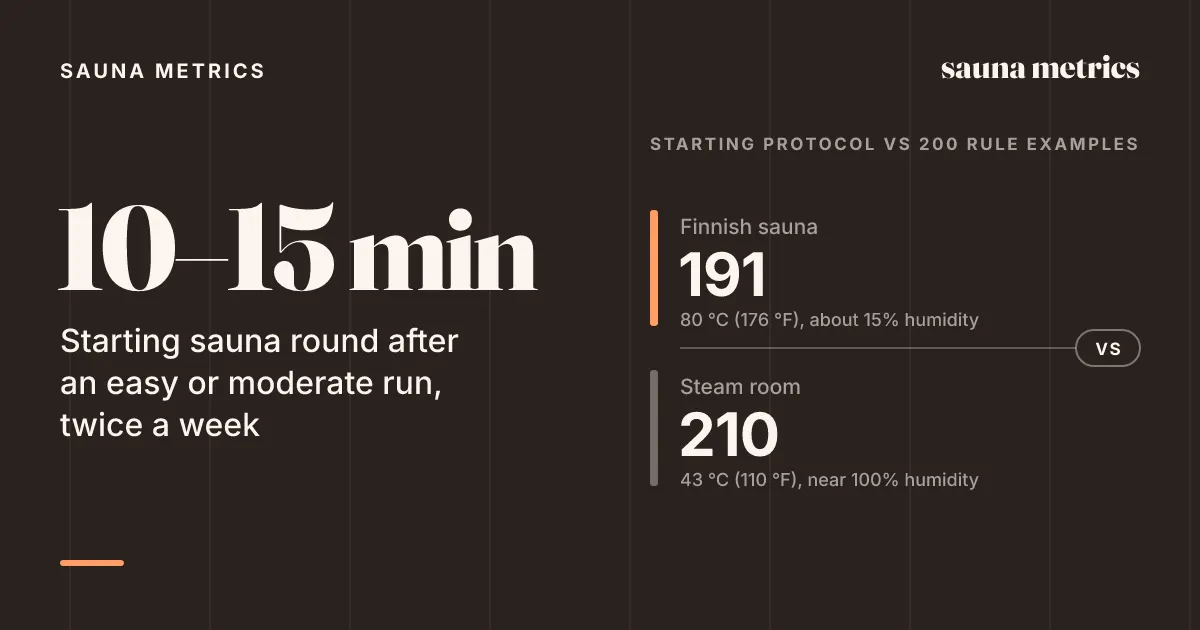
The 200 rule is a popular rule of thumb. You add the temperature in °F and the relative humidity in %, and try to keep the total at or below about 200. It is not a clinical standard, but it shows why humid heat is harder to tolerate.
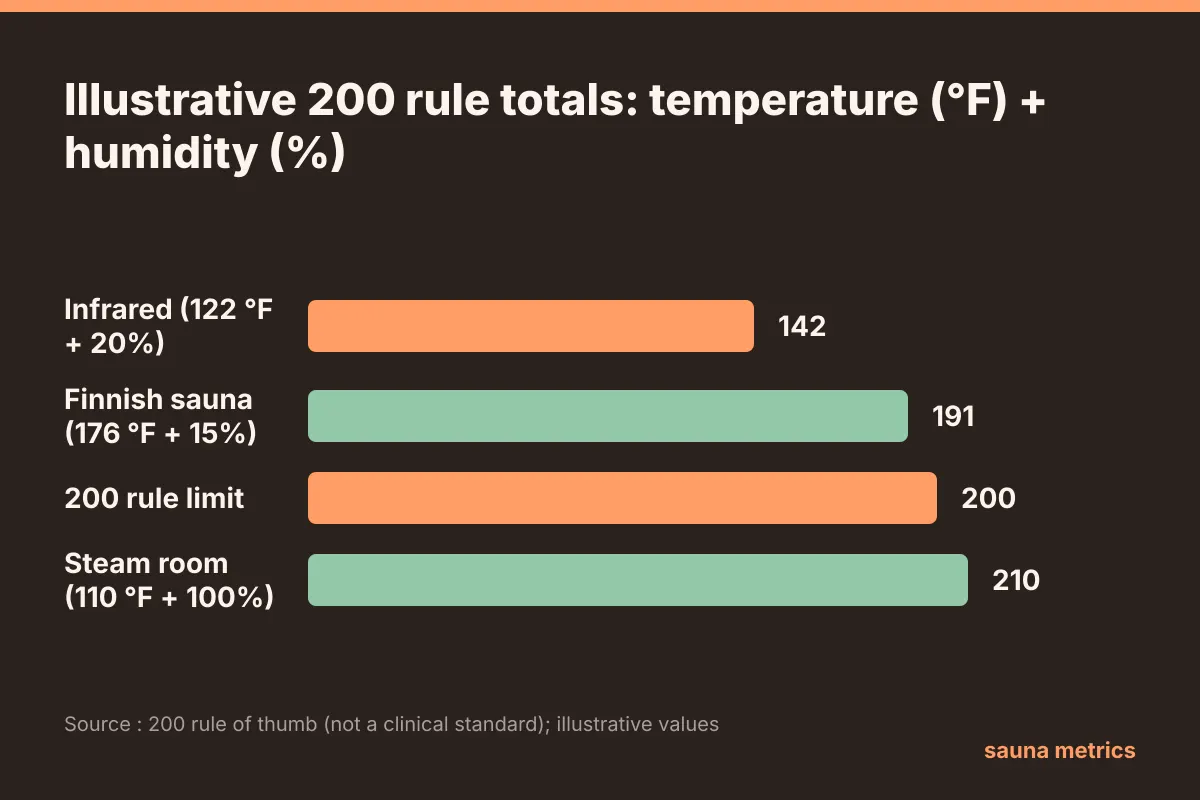
Illustrative examples: a Finnish sauna at 80 °C (176 °F) and about 15% humidity gives about 191. A steam room at about 43 °C (110 °F) and near 100% humidity gives about 210, which is above the line and much harder to tolerate.
Rehydrate for the fluid lost in the run and the sauna combined. Water is enough after short, light sessions. After long runs or heavy sweating, sodium and other electrolytes may help. See the guide on proper hydration after sauna. Sweat loss shown in the app is an estimate.
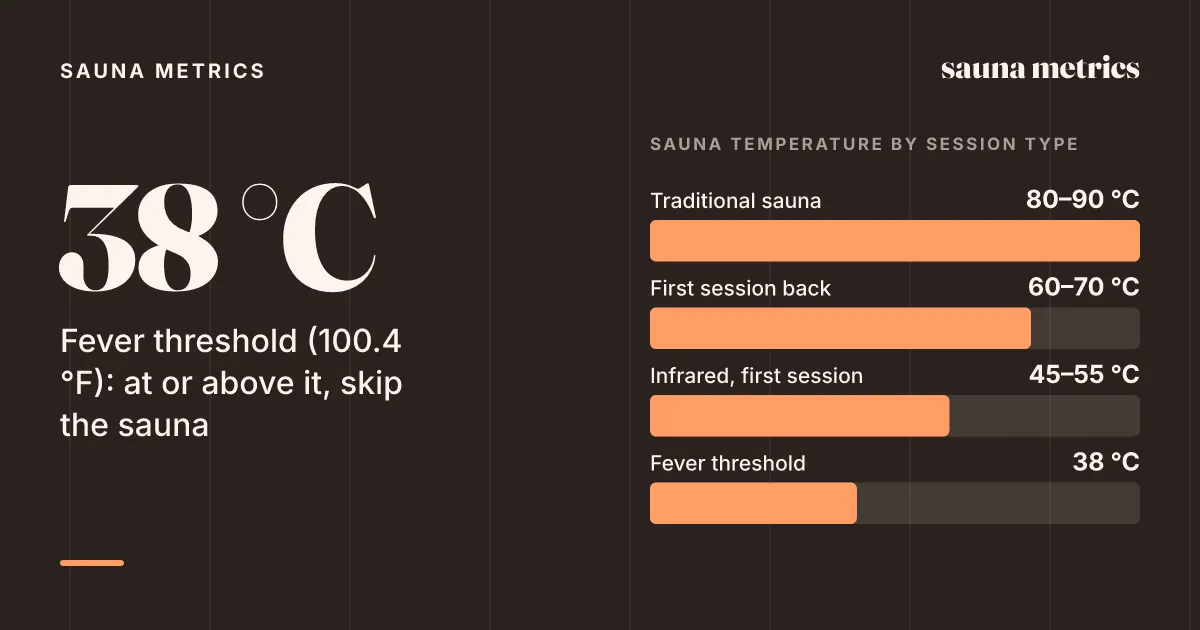
Skip the sauna after a marathon or race, when you are dehydrated, after alcohol, if you feel dizzy, or if you have a heart condition or are pregnant without medical advice. Read when to skip the sauna if you are sick too. Leave the sauna at the first sign of lightheadedness or nausea.
Sauna in a marathon plan: heat acclimation, off-season and infrared
For pre-race heat acclimation, a common practice is two to three weeks of regular post-run sessions, ending a few days before the start. This is a habit, not a proven formula. Test it during a training block, not in race week.
In the off-season, one or two sessions a week keep the routine alive. Observational studies link regular sauna use with cardiovascular outcomes in the general population. That is an association and does not prove cause and effect. For more, read about the cardiovascular benefits of heat.
For muscle soreness (DOMS), the evidence is limited and mixed. Infrared runs cooler, so it can be easier to tolerate after a hard run. Finnish heat gives a stronger cardiovascular load. The article on Finnish vs infrared sauna: which fits your routine goes deeper.
| Type | Typical temperature | Humidity | Session length | Best use for runners |
|---|---|---|---|---|
| Finnish sauna | 80–90 °C (176–194 °F) | About 10–20% | 10–15 min rounds | Heat adaptation, stronger cardiovascular load |
| Infrared sauna | 45–60 °C (113–140 °F) | Low | 15–30 min | Gentler option after a hard run |
| Steam room | 40–45 °C (104–113 °F) | Near 100% | 10–15 min | Relaxation; hardest to tolerate in terms of the 200 rule |
What about belly fat? Weight lost in a sauna is mostly water and returns after rehydration. Calories burned are an estimate and small, and there is no spot fat loss.
Runner's sauna checklist for the next four weeks
- Run first, drink, then sauna.
- Start with 2 sessions a week, with rounds of 10 to 15 minutes.
- Log each session in Sauna Metrics with temperature, humidity and mood.
- Review morning HRV, resting heart rate and sleep once a week.
- If resting heart rate climbs and HRV falls over several days, cut the sauna and the training load.
Install Sauna Metrics on your iPhone to log your sessions and see how your recovery trends respond over four weeks.
Is it good to run after a sauna?
Usually not for a quality session. Fluid loss and a raised heart rate make the same pace harder and increase the risk of dizziness. Run first and use the sauna afterward.
Is it better to walk for 1 hour or run for 30 minutes?
It depends on your goal and what your body can absorb that week. Running is more demanding per minute, while walking is easier to recover from.
What is the 200 rule sauna?
A rule of thumb that adds the temperature in °F and the relative humidity in %, aiming for a total of about 200 or less. It is not a clinical standard.
Is sauna good for losing belly fat?
Not directly. Weight lost in a sauna is mostly water and returns after rehydration, calories burned are small, and there is no spot fat loss.